

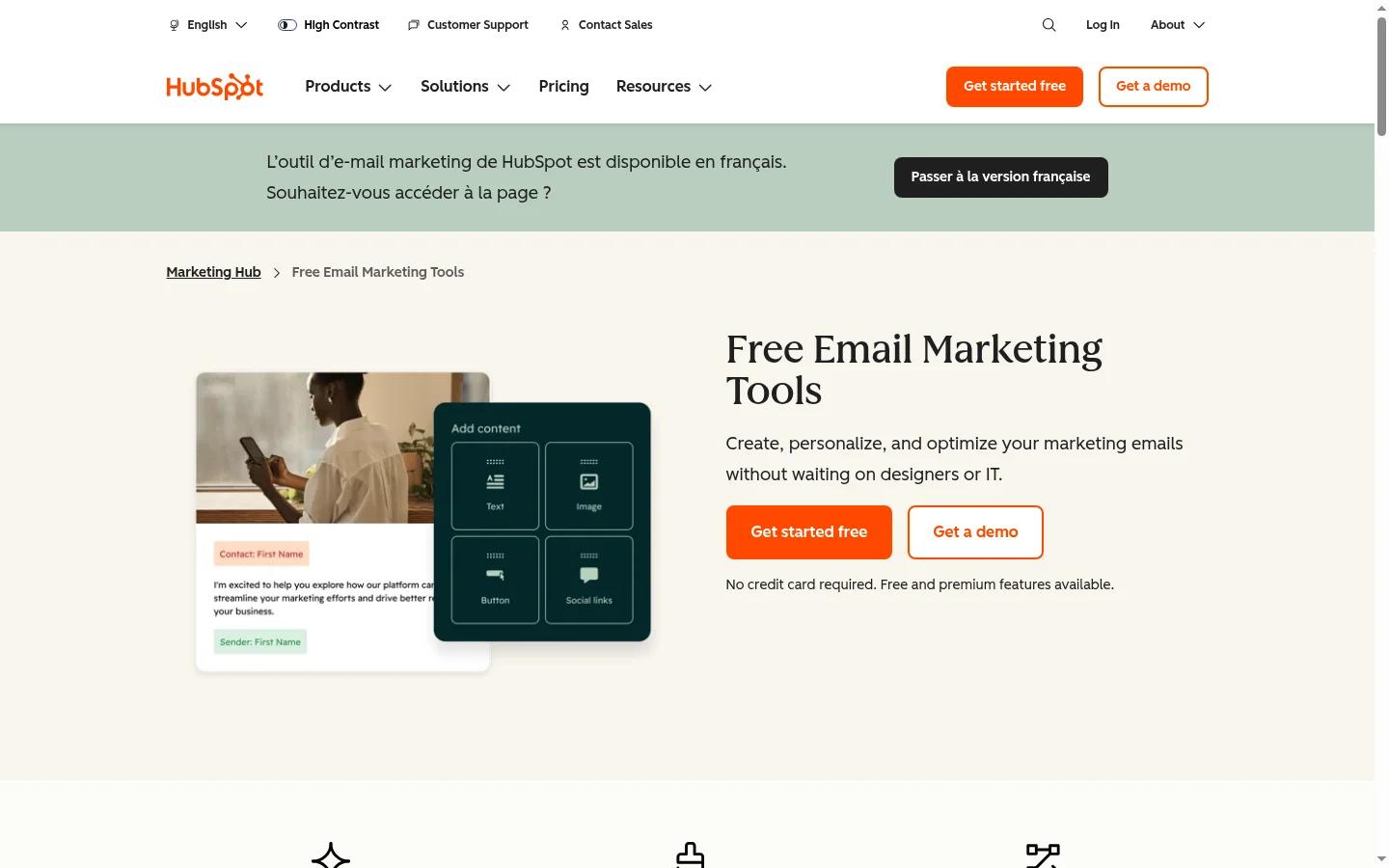
HubSpot Email Marketing is best viewed as "CRM-driven email marketing" rather than a generic AI writing portal. When evaluating it on the Best AI Email Writer site, the key isn't just whether it can generate fluent text, but whether it can reduce hesitation, minimize misunderstandings, and make outgoing content feel like it was written by one specific person to another. HubSpot Email Marketing is ideal for teams that manage email content, CRM, leads, and automation in one place. If you are looking for a "magic button" to generate all your emails at once, this might not be the best perspective; however, if you define your email goals first and integrate it into a proper workflow, its value becomes much clearer.
Core Positioning
The core value of HubSpot Email Marketing lies in connecting contact data with email content. This means it doesn't solve every email problem, but rather a critical link in the email workflow. Many users, when choosing an AI email tool, conflate writing, polishing, inbox management, cold outreach, and marketing automation, often ending up with a product that has many features but doesn't fit their specific scenario. A safer way to judge is to ask yourself: Am I currently stuck on drafting the first version, adjusting the tone, handling high-volume replies, bulk outreach, or segmenting marketing emails? The clearer the answer, the more worth it is to add HubSpot Email Marketing to your shortlist.
In terms of email quality, it should serve clear expression rather than making sentences longer. Good emails usually have three characteristics: a clear purpose at the beginning, only necessary facts in the middle, and a non-intrusive next step at the end. If HubSpot Email Marketing helps you reach such a draft faster, it is more useful than simply generating pretty paragraphs. Conversely, if you find yourself constantly deleting fluff, adjectives, and empty promises, it means you need stricter prompts or clearer usage boundaries.
Suitable Email Scenarios
It is well-suited for sales and marketing teams. In daily work, it can be used for client replies, partnership invitations, sales follow-ups, event notifications, internal synchronization, or rewriting English business emails, but the usage varies by scenario. Client replies prioritize factual accuracy and tone; sales outreach prioritizes the specificity of the opening line; marketing emails prioritize audience segmentation and CTAs; internal sync prioritizes brevity and clarity. Mixing these scenarios into the same template is the main reason AI email content starts to sound robotic.
Take a common example: If you are writing a cold email, don't just ask HubSpot Email Marketing to "make it professional." Better input includes who the target is, why you are reaching out now, the specific help you can provide, what you want them to do, and what should be avoided. The resulting draft is usually shorter and more human-like. If you are handling a rejection or complaint, first have it summarize the other party's true concerns, then generate two versions: one more restrained, one more proactive. Finally, have a human choose the tone rather than copying the first version directly.
User Experience and Workflow
When using HubSpot Email Marketing, we recommend breaking the process into three steps. First, organize the background without rushing to write the body. Second, ask it to provide an email structure, including the opening, core message, proof points, and CTA. Third, request the final draft and specify the tone, such as "direct but not aggressive," "polite but not overly formal," or "like a normal conversation between colleagues." This process may seem more tedious than a single prompt, but it significantly reduces filler and prevents the AI from hallucinating facts.
Perform a manual check before sending. The focus should not be on grammar, but on facts and relationships: Did you exaggerate product capabilities? Did you promise an impossible deadline? Did you turn a simple reminder into a pushy demand? Did you leave the recipient unsure of the next step? If it's an English email, be wary of excessive enthusiasm; if it's a Chinese business email, remove empty buzzwords. HubSpot Email Marketing can help you get close to a sendable version, but the final judgment must be made by a human.
Boundaries to Note
Light users may find the system a bit heavy. Especially in quotes, contracts, HR matters, customer complaints, legal commitments, and sensitive partnerships, we do not recommend letting any AI email tool decide the phrasing. It can help you rewrite the tone or outline a clearer structure, but it cannot confirm business facts for you. Once an email is sent, the sender bears the consequences, not the tool. For teams, considerations regarding permissions, approvals, customer data, and privacy boundaries are often more important than whether the output "sounds human."
Another boundary is the sense of repetition. Many AI emails naturally fall into a rhythm: greeting, expressing understanding, listing three points, and expecting a reply. It looks complete in the short term, but in the long term, it makes all emails look like the same template. When using HubSpot Email Marketing, you should actively request versions with different lengths, tones, and openings, then pick the one that best fits the relationship. A truly good email isn't the most "complete" one, but the one most easily understood and responded to by the recipient.
Recommended Usage
We recommend placing HubSpot Email Marketing within a clear email SOP: write the factual points first, generate the structure, create the draft, and finally perform manual editing. Prompts can include five fixed pieces of information: who the recipient is, the relationship, the purpose, must-have facts, and the desired next step. For sales and marketing, add target audience, trigger reasons, and negative constraints. For replies, paste the previous email first and have it summarize the sender's request before writing the response; this is more reliable than simply asking to "help me reply."
If multiple team members are using it, it is best to establish standard tones rather than letting everyone improvise. For example, "Founder Outreach," "Customer Success Reply," "Event Invitation," or "Partnership Rejection." Keep real examples for each tone and have HubSpot Email Marketing rewrite based on those examples. This leverages AI to save drafting time without turning brand emails into a pile of identical templates. The more powerful the tool, the more you need clear usage rules; otherwise, the speed of generation will only amplify content issues.
Who Is It For?
HubSpot Email Marketing is for those who already know which email problems they need to solve. Sales teams can use it to shorten outreach drafting time, operations teams can use it to rewrite event notifications, and founders can use it to turn rough ideas into polished emails. It is not for those who have no input and expect the tool to decide their business strategy, nor for those who want to automate all their emails.
The final judgment is simple: if HubSpot Email Marketing helps you write clear, specific, and sendable emails faster without making the content feel templated, it is worth a try. If it just expands short sentences into long paragraphs, turns simple requests into marketing fluff, or makes you spend more time editing before sending, then you should switch tools or tighten your prompts. The value of AI Email Writer is not to help people write more emails, but to help them write emails with less fluff, higher accuracy, and a better chance of getting a response.